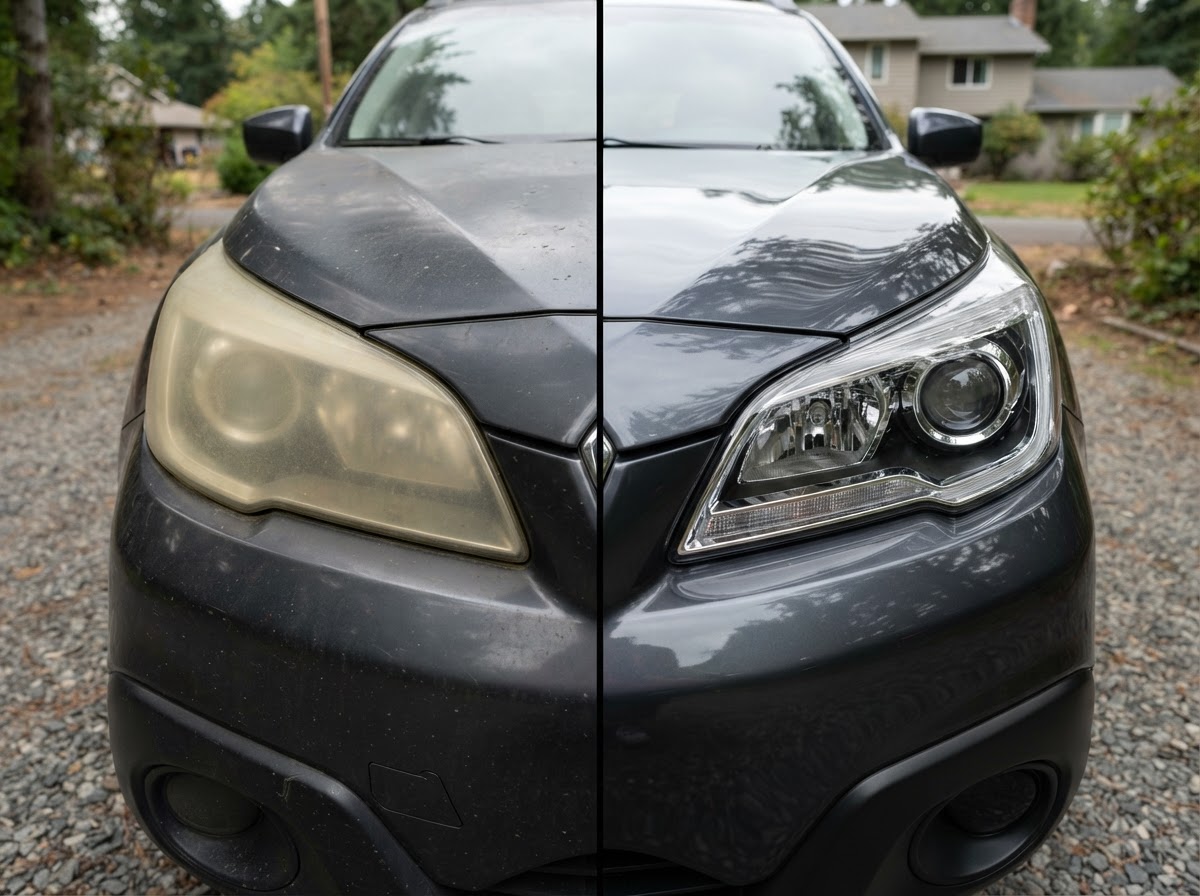
Yellowed headlights aren't just cosmetic. Cloudy lenses make an otherwise clean car look older, but the bigger problem is that they cut your nighttime visibility. If you drive the dark stretches between Leander, Liberty Hill, Georgetown, and Cedar Park, or just commute home after sunset in Austin, clear headlights matter.
Here's what causes the haze, why it's a safety issue, and how sanding, polishing, and a UV sealant bring lenses back to clear.
Why headlight lenses turn yellow and cloudy
Most modern headlight lenses are made of polycarbonate, a tough plastic. From the factory, they're protected by a clear UV-resistant layer. Over time that layer breaks down, mainly from:
- Sun exposure. UV rays are the main cause, and Central Texas gets a lot of sun.
- Heat. Parking in the sun and the heat from the bulbs themselves both age the lens.
- Road debris and grit. Sand and small particles at highway speed slowly pit the surface.
- Harsh chemicals. Strong cleaners and some automatic wash chemicals can speed up the breakdown.
Once the protective layer fails, the plastic underneath oxidizes. That's the yellow, foggy, sometimes crusty look you see on older cars, and on not-so-old ones that live outside.
Why it's a safety issue, not just a looks issue
A clouded lens acts like frosted glass. Instead of projecting a clean, focused beam onto the road, it scatters light. That means:
- Less light reaches the road ahead, so you see less at night and in the rain.
- The beam pattern gets diffused, so obstacles, animals, and road edges are harder to pick out.
- More glare for oncoming drivers, because scattered light spreads in directions it shouldn't.
Because the change happens gradually, many drivers don't notice how much they've lost until the lenses are cleared and the difference is obvious on the next night drive.
Signs your headlights need attention
- The lenses look yellow, amber, or milky instead of glass-clear
- The surface feels rough or chalky to the touch
- Your low beams seem dimmer or shorter than they used to
- You catch yourself relying on high beams more often on unlit roads
- One headlight looks noticeably cloudier than the other
If any of these sound familiar, restoration is usually the fix. Replacing the whole headlight assembly is rarely necessary just for haze.
How headlight restoration works
Proper restoration removes the damaged, oxidized layer and then protects the fresh surface. It isn't just a wipe with a cleaner. There are three steps.
1. Sanding
The oxidized, yellowed surface is carefully wet-sanded away, working through progressively finer grits. This removes the failed coating and the haze in the plastic so you're back to clean polycarbonate.
2. Polishing
Sanding leaves the lens uniformly hazy, which is expected. Machine polishing then refines those sanding marks into an optically clear finish, the same principle we use when polishing paint.
3. UV sealant
This is the step quick fixes skip. Freshly polished polycarbonate has no UV protection left, so without a sealant it can start yellowing again. A UV sealant replaces the protective layer the factory coating used to provide and helps the clarity last.
What about the toothpaste trick?
Home remedies and quick wipe-on products can make a lens look better for a little while because they lightly polish the surface. They don't remove deeper oxidation, and they don't restore UV protection, so the haze tends to come back. Real restoration is sanding, polishing, and sealing.
Keeping your headlights clear afterward
- Park in the shade or a garage when you can to cut UV exposure.
- Wash lenses gently with pH-neutral car soap and microfiber, the same as your paint.
- Avoid harsh household cleaners on the lenses.
- Keep an eye out for early yellowing and deal with it before it becomes heavy oxidation.
Add it to your next detail
Headlight restoration is one of our add-ons, listed from $35. Add-ons are done during your scheduled appointment, with no separate trip. It pairs naturally with an Exterior Detail (from $149) or a Full Detail (from $249), so the whole front of the car looks fresh. See every option on our Add-Ons page. Add-ons start from $30.
KlenCars is mobile. We bring our own water, power, and equipment to your home or workplace in Austin, Cedar Park, Leander, Liberty Hill, Georgetown, and West Lake Hills, and vehicle drop-off is also available.
Book your detail with headlight restoration or call (737) 379-0956. Tell us your vehicle and we'll confirm scope and pricing before we arrive.